
How to Find Your Students’ Spanish Level Without a Test Day

It’s November, and you’ve had this class for almost three months. You know who talks and who hides. But if someone asked you where each student actually is in Spanish, could you say?
Most of us couldn’t, not with any confidence. Half of Spanish 2 is really still in Spanish 1. A few students are bored because they’re way ahead. And the only tool we have to find out is a test day nobody enjoys and that takes a week to grade.
There’s an easier way to get a first read.
Why guessing levels costs you the whole unit
When you plan for the middle of the class, the students below it get lost and the ones above it check out. Usually the plan is fine; you just can’t see who needs what. And you can’t pick the right song, reading or activity for a student if you don’t know where they are.
That’s why we built a free Spanish proficiency assessment that any student can take, in class or at home.
How the free assessment works
- It’s free and needs no account. Students go to the free Spanish level test and start right away.
- It’s adaptive. Questions get harder or easier based on how each student answers, so a beginner isn’t stuck on impossible questions and an advanced student isn’t bored.
- It gives a level, not just a score. Each student gets an estimate of where they are on the CEFR scale.
- Results are shareable. Students can share their result with you, so you can start grouping and planning the next day.

Reading the results in plain words
You’ll probably see a few of these, so here’s a quick guide:
CEFR level | Roughly what it looks like in class |
|---|---|
A1 | Understands familiar words and very simple phrases |
A2 | Handles simple, everyday topics and short exchanges |
B1 | Follows the main points on familiar topics and can tell a simple story |
B2 | Understands longer speech and can share and defend an opinion |
If you think in ACTFL terms, A1 lines up roughly with Novice High, A2 with Intermediate Low to Mid, and B1 with Intermediate Mid to High, though the scales don’t match perfectly.
What to do the next day
Once you know who’s where, you don’t need three separate lesson plans. Try this:
- Same song, different tasks. Play one song for everyone. A1 students match words to pictures, A2 students fill in missing words, and B1 students summarize the story.
- Smart pairs. Pair a stronger student with a developing one for listening games, so both stay busy.
- One stretch goal. Give students near the next level one task that pushes them a little past their result.
From one test to the whole year with Pulse
A single result is a snapshot. If you want to see how each student moves over the year, that’s what Pulse is for. Pulse tracks student progress on ACTFL and CEFR levels as they play, flags skill gaps, and suggests what lesson to try next, without another test day. The assessment result feeds right into it, so you’re not starting from zero.

Pulse is rolling out to Pro teachers first. Read more about Pulse.
Frequently asked questions
Is there a free Spanish proficiency test for students? Yes. Roxxem’s Spanish assessment is free, adaptive, and doesn’t need an account.
What level is my student in Spanish? A proficiency test gives you a starting estimate on the CEFR scale. Watching students over time, in class and with tools like Pulse, gives you the fuller picture.
How is CEFR different from ACTFL? CEFR is the European scale (A1 to C2) and ACTFL is the US scale (Novice to Distinguished). They describe similar skills but don’t map one to one.
See where your class really is. Try the free Spanish proficiency assessment and plan Monday around real levels.

Pulse helps world language teachers track student progress on ACTFL and CEFR levels, spot skill gaps and pick the right lesson next, without a test day.

Six quick classroom checks for listening, vocabulary, grammar, comprehension, speaking and writing, so you can see who's ahead and who's quietly lost this fall.
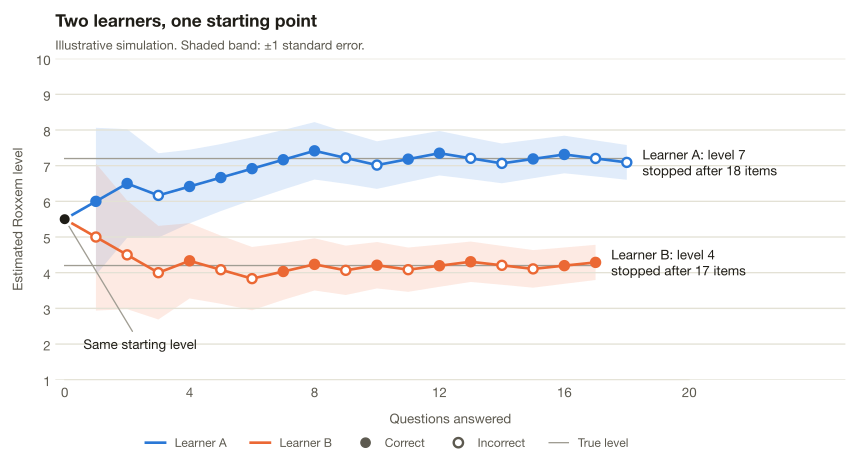
See how Roxxem's adaptive proficiency test places learners in about 10 minutes, and how we generate and validate its 10k-item bank with LLM evals.